Journal of Teaching and Learning with Technology
Vol. 11 No. 1 (2022)
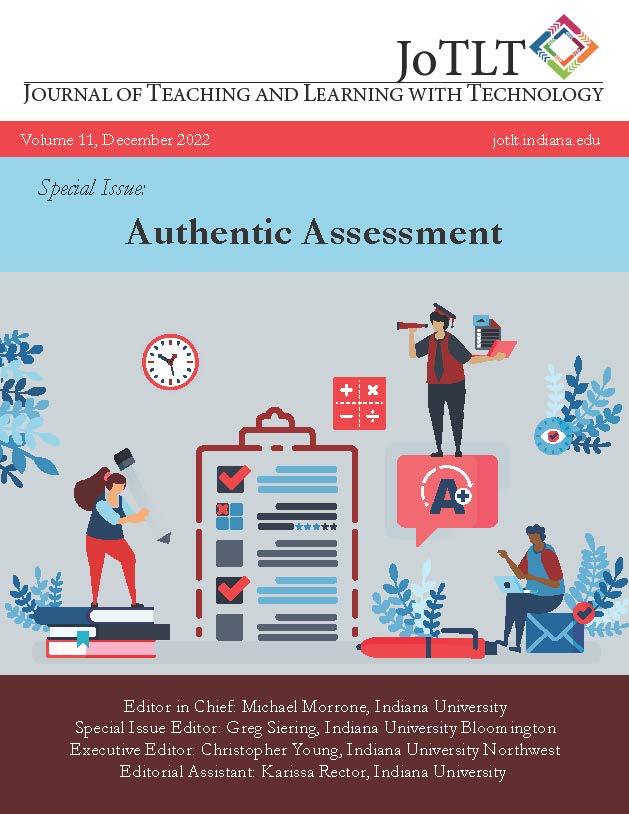
We are pleased to announce the publication of JoTLT’s special issue on uses of technology to enhance authentic assessment. Before giving a brief history of this issue, we would like to thank our guest editor, Greg Siering, Director of the Center for Innovative Teaching and Learning at Indiana University Bloomington, for his dedication to publication of this issue and for sharing his knowledge and insights throughout the publication process and in the issue’s Introduction.


On December 2, 2021, we issued the call for proposals and received 35 proposals. The editorial team considered the proposals using a blind review process and invited 16 authors to submit full manuscripts. We received 11 manuscripts, which were sent out for double blind review. Of those, 7 have been included in this issue.


We would like to thank our authors for sharing their experiences so that we can all learn from each other. And we would like to thank our invited reviewers, many of whom also authored articles for the issue, for providing their expertise with the authors and the editorial team.

Journal of Teaching and Learning with Technology
Vol. 10 No. 1 (2021)
We are pleased to announce the publication of this special issue on transitioning teaching to remote and online learning during the 2019 coronavirus disease (COVID-19) pandemic. On April 7, 2020 we issued the call for proposals and received 87 proposals. Based on blind desk reviews, the editors invited 57 authors to submit full manuscripts. We received 53 manuscripts, sent out for double blind review. Of those, 41 have been included in this issue, which seeks to give a broad perspective chronicling the varied adaptations to teaching and the impacts, personal and professional, caused by the transition.


We would like to thank our authors for sharing their experiences so that we can all learn from each other. And we would like to thank our invited reviewers, many of whom also authored articles for the issue, for providing their expertise and insights with the authors and the editorial team.


Michael Morrone,
Editor-in-Chief


Christopher J. Young
Executive Editor

Journal of Teaching and Learning with Technology
Vol. 9 No. 1 (2020)
Preface


The notion of self-regulated learning refers to teaching practices that include a goal of helping students learn how to learn, in other words to take ownership of their learning; it includes the cognitive, metacognitive, behavioral, motivational, and emotional/affective aspects of learning. This special issue of the Journal of Teaching and Learning with Technology focuses on the promotion of self-regulated learning supported by the learning management system (LMS).


We are pleased to have had the opportunity to collaborate on this issue with Robin K. Morgan, Professor of Psychology and Director of the Institute for Learning and Teaching Excellence at Indiana Univeristy Southeast, and Julie Saam, Associate Vice Chancellor for Academic Affairs and Director of the Center for Teaching, Learning, and Assessment, Professor of Education at Indiana University Kokomo. We also thank the invited reviewers who shared their expertise and insights with the authors and editorial team. The 12 essays in this issue were selected from 38 proposals. The rigorous process of selection included a desk review of the proposals by the editorial team and blind review of invited manuscripts. Together the articles share avenues for ongoing, deepening understanding of the technology-classroom connections that faculty and students encounter every day. We thank our authors for their dedication to a scholarly approach to pedagogical innovation and their commitment to our students and their learning.


Michael Morrone,
Editor-in-Chief


Christopher J. Young
Managing Editor


Robin K. Morgan
Guest Editor


Julie Saam
Guest Editor


Reviewers


Sumreen Asim, Indiana University Southeast


Angela Benson, University of Alabama


William Cain, University of Wyoming


Joseph Rene Corbeil, University of Texas Rio Grande Valley


Erick Dubuque, University of Louisville


Steve Katsikas, Spalding University


Gina Londino-Smolar, Indiana University–Purdue University Indianapolis


Adam Maksl, Indiana University Southeast


Jean Mandernach, Grand Canyon University


Michelle Miller, Northern Arizona University


Ben Motz, Indiana University


Mimi O’Malley, Spalding University


Sridhar Ramachandran, Indiana University Southeast


Christian Rogers, Indiana University–Purdue University Indianapolis


Jeanne Slattery, Clarion University


Melinda Stanley, Indiana University Kokomo


Michael Stevenson, University of Southern Maine


Megan Sumeracki, Rhode Island College


Rachelle Tannenbaum, Anne Arundel Community College


Karen Vignare, Association of Public and Land-Grant Universities

Journal of Teaching and Learning with Technology
Vol. 8 No. 1 (2019)
Preface


With increasing frequency faculty find themselves in classrooms enhanced to support pedagogical flexibility and with a wide and growing range of technological tools at their disposal. This special issue of the Journal of Teaching and Learning with Technology focuses on the use of technology to enhance teaching and learning in classroom and informal learning spaces. 


We are pleased to have had the opportunity to collaborate on this issue with Anastasia (Stacy) Morrone, Professor of Educational Psychology and Associate Vice President for Learning Technologies at Indiana University. We are grateful to J.D. Walker, Research Associate in the Center for Educational Innovation at the University of Minnesota, for writing the foreword. We also thank the invited reviewers who shared their expertise and insights with the authors and editorial team. The eight essays in this issue were selected from 36 proposals. The rigorous process of selection included a desk review of the proposals by the editorial team and blind review of invited manuscripts. Together the articles share avenues for ongoing, deepening understanding of the technology-classroom connections that faculty and students encounter every day. We thank our authors for their dedication to a scholarly approach to pedagogical innovation and their commitment to our students and their learning.


Michael Morrone,
Editor-in-Chief


Christopher J. Young
Managing Editor


Anastasia (Stacy) Morrone
Guest Editor


Reviewers


Serdar Abaci, Newcastle University


Tessa Bent, Indiana University


Christopher Brooks, EDUCAUSE


Martyn Keeler Clark, University of Maryland


Sam Craighead, Ohio State University


Jean Florman, University of Iowa


Rebecca Frazee, San Diego State University


Dana Gierdowski, EDUCAUSE


Alia Katherine Lancaster, University of Maryland


Megan Christina Masters, University of Maryland


Peggy McCready, Northwestern University


Jeremy Price, Indiana University-Purdue University 


Joshua Quick, Indiana University


Jae-Eun Russell, University of Iowa


Stephanie Serriere, Indiana University-Purdue University Columbus


Lisa Stephens, SUNY-Buffalo + FLEXspace


Heath Tuttle, University of Nebraska-Lincoln


JD Walker, University of Minnesota


Ava Wolf, University of Illinois-Champaign Urbana


Meina Zhu, Wayne State University

Journal of Teaching and Learning with Technology
Vol. 12 No. 1 (2023)

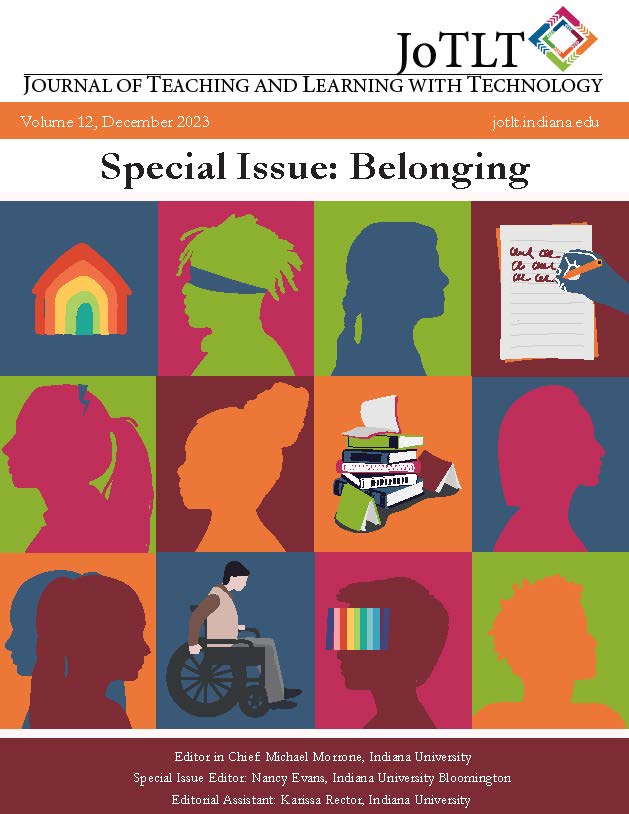
We are pleased to announce the publication of JoTLT’s special issue on belonging. Before giving a brief history of this issue, we would like to thank our guest editor, Nancy Evans (Senior Lecturer in Communication, Professional, and Computer Skills at IU Bloomington Kelley School of Business), for her dedication to publication of this issue and for sharing her knowledge and insights throughout the publication process and in the issue’s Introduction.


On January 11, 2022, we issued the call for proposals and received 28 proposals. The editorial team considered the proposals using a blind review process and invited 15 authors to submit full manuscripts. We received 13 manuscripts, which were sent out for double blind review. Of those, 11 have been included in this issue.


We would like to thank our authors for sharing their experiences so that we can all learn from each other. And we would like to thank our invited reviewers, many of whom also authored articles for the issue, for providing their expertise with the authors and the editorial team.

Journal of Teaching and Learning with Technology
Vol. 13 No. 1 (2024)

We are pleased to present JoTLT’s special issue on applying technology to enhance large-enrollment classes. We would like to thank our guest editor, Benjamin Burlingham (Senior Lecturer in Chemistry at IU Bloomington), for his dedication to the publication of this issue and for sharing his knowledge and insights throughout the publication process and in the issue’s introduction. His introduction follows this
acknowledgment.


We would like thank our authors for sharing their experiences so that we can all learn from each other. And we appreciate our invited reviewers, many of whom also authored articles for the issue, for providing their expertise with the authors and the editorial team. Lastly, we would like to acknowledge the cover artwork for this publication was generated with Microsoft's Copilot. The final design involved numerous iterations of prompts and feedback. Additionally, we conducted thorough due diligence to ensure the illustration was not created by a human artist.


Please enjoy this issue and stay tuned for our next special issue on practical uses of generative artificial intelligence coming in December 2025.


Michael Morrone, Co-Editor-in-Chief
Kathy Berlin, Co-Editor-in-Chief
Karissa Rector, Editorial Assistant

Journal of Teaching and Learning with Technology
Vol. 14 No. 1 (2025)

We are pleased to present JoTLT’s special issue on the practical uses of generative AI in enhancing teaching and learning in higher education. We would like to thank our guest editor, Adam Maksl (Professor of Journalism & New Media, IU Indianapolis), for his dedication to the publication of this issue and for sharing his knowledge and insights throughout the publication process and in the issue’s introduction. 


We would like thank our authors for sharing their experiences so that we can all learn from each other. And we appreciate our invited reviewers, many of whom also authored articles for the issue, for providing their expertise with the authors and the editorial team. Lastly, we would like to acknowledge the cover artwork for this publication was generated with Microsoft's Copilot. The final design involved numerous iterations of prompts and feedback. Additionally, we conducted thorough due diligence to ensure the illustration was not created by a human artist.


Please enjoy this issue and stay tuned for the call for abstracts for the 2026 special issue.


Kathy Berlin, Co-Editor-in-Chief
Michael Morrone, Co-Editor-in-Chief
Karissa Rector, Editorial Assistant