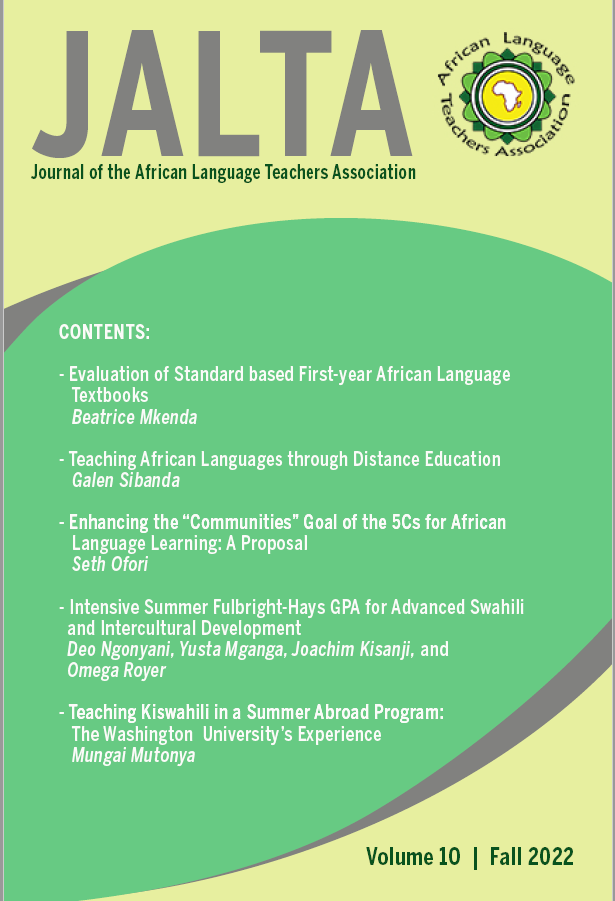
The Journal of African Language Teachers’ Association (JALTA), published annually in collaboration with the National African Language Resource Center (NALRC), is dedicated to topics related to the teaching and learning of African languages in foreign-language contexts. The Journal primarily seeks to address the interests of language teachers, administrators, and researchers. The journal welcomes manuscripts describing innovative and successful teaching methods, as well as those reporting on educational research or experimentation in African languages. We also invite scholarship focusing on African language use, policy, and related sociocultural practices. Papers presented at the annual African Language Teachers’ Association (ALTA) Conference are considered for publication; additional manuscripts from all members of the profession are warmly welcomed.

Vol. 13 (2026): Journal of African Language Teachers Association (JALTA)

JALTA is the official journal of the African Language Teachers Association, serving as a vital forum for advancing research, ideas, and interventions in African language pedagogy, programming, and advocacy. Published annually in collaboration with the National African Language Resource Center, JALTA features scholarly articles and practical and analytical insights for and by teachers, researchers, and administrators committed to African language education.  JALTA's ISSN: 1524-9956.

Volume 13, Spring 2026

Table of Contents

1 | Beyond Title VI: A Thriving Framework for African Language Programs in U.S. Higher Education - Kazeem Kẹ́hìndé Sanuth and Kim Poole

9 | Open Educational Resources in African Languages: An Evidence-based Case Study of Elementary Kiswahili Textbook - Peter Otiato Ojiambo, Brenda Aromu Wawire, and John Munyui Muchira

31 | Technology Integration and Yoruba Language Pedagogy in Lagos State, Nigeria - Adebisi Banjo, Oluwatosin Adebomeyin, and Tolulope Grace Banjo

53 | Implementing AI in African Language Instruction: Practical Ideas and Strategies - Matthew Ajibade, Oluwasegun Matthew Amoniyan, and Oluwafunke Brinda Ogunya

74 | Beyond the Conventional Classroom: Opportunities and Challenges in Online Language Teaching - Amlaku B. Eshetie

80 | Scenic Storytelling: Scenography as a Culturally Grounded Pedagogical Innovation in Yoruba Language and Culture Education in Nigerian Secondary Schools - Adebayo John Badeji and Abdulmalik Adakole Amali

98 | Integrating Educational Technologies in University-Level Amharic Instruction: Pedagogical Applications for a Less Commonly Taught Language - Tafessework Gebeyehu

108 | Teaching Reading in Kiswahili in Kenyan Grades 1–3: Exploring Direct Instruction Strategies and Curriculum Support - Everlyn Achieng’ Oluoch-Suleh

125 | Impact of Memrise on Yoruba Vocabulary Knowledge among Elementary School Pupils in Ilorin - Bukunmi Ogunsola and Faith Oluwadamilola Ayoade

139 | Integrating Communicative Language Teaching (CLT) into Hausa Classrooms: A Pedagogical Model for Secondary Schools in Nigeria - Baba Hussaini

155 | Language Policy in South Africa and the Century-old Discourse on the Development of the Indigenous Languages - Godfrey Vulindlela Mona and Buyiswa Mavis Mini

171 | Language Policy and Practice in Tanzania and South Africa: Comparative Perspectives on Policy, Challenges, and Scholarly Debates - Anna Mwalagho

184 | Why Students Study Yorùbá: Motivation and Perceived Value at a U.S. University - Kazeem Kẹ́hìndé Sanuth and Oluwafunke Brinda Ogunya

196 | Bringing Wolof Orality into the Classroom through QR-Coded Proverbs - Oumou Dat

207 | Indigenous Languages and Real Estate Pricing in Kenya: Evidence from Kisii and Migori Counties - Bernard M. Omboi and Quin Elizabeth Awuor.

Published: 2026-04-22

Technology Integration and Yoruba Language Pedagogy in Lagos State, Nigeria

Adebisi Elizabeth Banjo, Mr. Oluwatosin Adebomeyin, Ms Tolulope Grace Banjo

31-52

Implementing AI in African Language Instruction: Practical Ideas and Strategies

Matthew Ajibade, Oluwasegun Matthew Amoniyan, Oluwafunke Brinda Ogunya

53-73

View All Issues